Trezor Login – Secure Access to Your Crypto Wallet
This updated version offers a completely fresh, rewritten explanation of the Trezor login process. Whether you're logging into your wallet for the first time or returning after a long break, this guide delivers a detailed walkthrough of how Trezor Suite and your hardware wallet work together to protect your digital assets. Everything has been rewritten from scratch for clarity and simplicity.
Understanding the Trezor Login Process
Logging in with a Trezor wallet is fundamentally different from traditional website logins. Instead of depending on online passwords or cloud-stored credentials, the Trezor login system ensures that the private keys controlling your crypto never leave the hardware device. This structure eliminates many of the vulnerabilities associated with digital asset management and places full ownership directly into your hands. This guide provides a full walkthrough of the login process, covering everything from connecting your Trezor to accessing your crypto dashboard in Trezor Suite.
To begin, connect your Trezor device to your computer using the included USB cable. The moment you plug it in, the device powers up and displays instructions on its screen. This initial connection is the first layer of security, ensuring that only a physically present user can start the login flow. Unlike software wallets, Trezor requires hands-on interaction before any operation can begin.
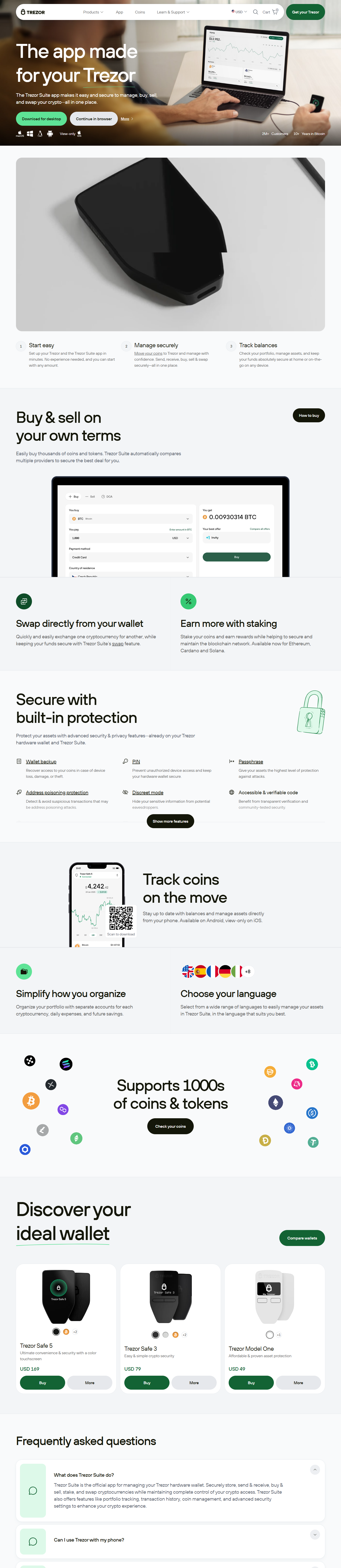
Next, launch Trezor Suite, the official application for managing accounts, verifying transactions, and monitoring your crypto portfolio. Once opened, Trezor Suite automatically detects your hardware wallet and prompts you to proceed with authentication. Because your private keys never touch the computer, even a compromised machine cannot access your wallet without your physical confirmation on the Trezor device.
When prompted to unlock your device, you will enter your PIN. Trezor’s PIN-entry system is intentionally designed to prevent keylogging and screen-recording attacks. The number layout appears randomly inside Trezor Suite while the true layout is visible only on the device screen. This ensures that only you know the correct sequence. After the PIN is entered successfully, your wallet unlocks and is ready to pair with Trezor Suite.
Many users also choose to enable an optional passphrase. Unlike the recovery seed, the passphrase is not stored on the device and must be entered manually each time. It acts as a security layer that creates a brand-new hidden wallet on top of your existing seed. If you're looking for advanced protection, this feature ensures that even if someone gains access to your recovery seed, they still cannot reach your funds without the passphrase. Depending on your model, you can input the passphrase on the computer or directly on the device screen.
Once your authentication is complete, Trezor Suite opens your dashboard instantly. Here you can explore your balances, track your transactions, and perform operations like sending, receiving, or exchanging assets. Because Trezor signs all transactions internally, your private keys never leave the wallet, and every action must be confirmed physically. This ensures absolute control over your account activity.
As with any crypto platform, security should be a top priority. Phishing pages, harmful browser extensions, and fake support agents are some of the most common threats. However, the Trezor login system is designed specifically to prevent these attacks. The most important rule is that your recovery seed should never be typed into a computer or given to anyone. Trezor will never request your seed online, and any platform that does should be avoided immediately.
While logged in, you can also access advanced Trezor Suite features such as portfolio tracking, integrated trading, account labeling, and multi-asset management. For users who work with several cryptocurrencies across different chains, Trezor Suite provides a secure environment to manage everything in one place. With regular firmware updates and an easy-to-use interface, the system continues to evolve to meet modern security standards.
Logging out of Trezor Suite is simple and instantaneous. All you need to do is disconnect your hardware wallet from the USB port. Without the device, your accounts cannot be accessed, viewed, or manipulated. This makes your wallet safe even on shared computers or environments with low trust.
With this newly rewritten guide, you now have a thorough understanding of the Trezor login system. The combination of hardware-based security, offline key storage, and physical confirmation ensures that your digital assets remain under your full control at all times. No online login can match the protective layers that Trezor provides, making it one of the most trusted tools for safely managing cryptocurrency.